- Unrelenting Progress
- Posts
- [UP 025] - How to see the problem differently with these questions
[UP 025] - How to see the problem differently with these questions
PLUS the cheat sheet liars don't want you to know

Utkarsh Kaushik
October 02, 2023
Apparently, it’s October.
Welcome back to UP. Edition #025.
I hope you’ve been taking the opportunities to grow that have come you’re way this week.
Without further ado, let’s have a little look at edition 25’s lineup. As usual, I've got a trio of insights that might just reshape the way you think, eat, and interact:
🤔 Four Questions for Four Goals: Ever made a hasty decision you later regretted? We'll explore how the art of asking the right questions could have saved some of one tech giant billions.
🍔 Sneaky White Stuff: Dive into the hidden world of our everyday foods. Discover why that 'healthy' snack might not be so harmless and how to navigate the maze of modern-day nutrition.
📖 The 'H' in Humanity: Drawing from ‘The H Factor of Personality,’ we'll delve into the essence of honesty, humility, and integrity. Can you spot a genuine high 'H' individual from an imposter? After this, you will.
Let’s get this started.
Four Questions for Four Goals

Story of my school life
Despite pouring billions into their efforts, their swings kept missing.
The tech giant, in its race to compete with other messaging giants like WhatsApp and iMessage, kept launching new apps without a clear strategy.
Users were confused, adoption was fragmented, and none of the apps truly took off as a dominant messaging platform.
Not so long ago, Google had built a collection of messaging platforms - ‘Hangouts’, ‘Allo’, and ‘Duo’ but none really had the results they were looking for until they finally landed on ‘Chat’.
And this kind of story is not just exclusive to Google. It happens far more than you’d think across multiple industries.
Where there’s plentiful resources, efficiency gets prioritized over effectiveness.
This situation could arguably have been avoided with a more deliberate approach.
Instead of rushing to launch new products, what if the teams at Google had taken a step back?
What if before building, they’d asked a wider range of questions about the broader landscape, user preferences, and the company's long-term vision?
Such a methodical approach, driven by the right questions, might have led to a more cohesive strategy and a singular, more successful product.
The Power of Asking the Right Questions
This week in my reading I came across a neat little Harvard Business Review book on Critical Thinking (HBR books I find are great resources of high-impact ideas in just a few pages. Great reads).
One of the ideas in the book was around the concept of asking questions.
As the Google example illustrates, sometimes in order to truly understand the problem at hand, whether professionally or even in our personal lives, we need to slow down and ask questions.
But not just any questions.
The right ones based on our current view of the problem and our goals. Let’s take a closer look:
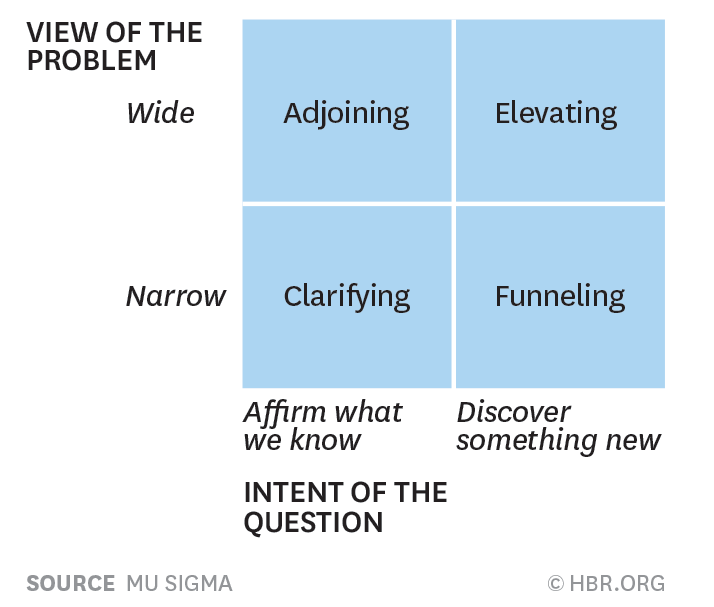
Clarifying Questions: Get clear first.
Positioned where our view of the problem is narrow and our intent is to affirm what we know.
These questions seek clarity. "Can you elaborate on that?" or "What do you mean by that?" serve to eliminate ambiguities and ensure everyone's on the same wavelength.
Adjoining Questions: Think laterally.
These reside in the space where our view of the problem begins to widen, but our intent remains to affirm our understanding. They encourage us to explore adjacent or related areas.
Questions like "How would this solution work in another market?" or "What if we approached it from this angle?" help us see beyond the immediate context.
Funneling Questions: Dive deep into the details.
Here, while our view of the problem remains narrow, our intent shifts towards discovering something new.
These questions delve into the specifics, probing deeper layers of the issue. "What led us to this conclusion?" or "Why did we choose this approach over that one?" can unearth hidden assumptions or biases.
Elevating Questions: Don't lose sight of the big picture.
Positioned where both our view of the problem is wide and our intent is to discover new insights.
These questions pull us back to see the overarching picture, ensuring we don't get lost in the weeds. "In the grand scheme of things, how does this fit in?" or "Are we still aligned with our primary objective?" guide us to connect the dots and see the broader implications.
So by understanding where our questions sit within this framework, we can tailor our questioning to be more effective.
We can both affirm our existing knowledge but also discover new insights as we tackle challenges. The perfect blend.
And with that, hopefully, no Google Alo app launching-like decisions in our lives (I didn’t even know about this until my research!)
So what problem will you put through this 2 × 2?
Have a think. And while you do, let’s talk about something holding us back with our health, yet we happily add to our food every day.
Sneaky White Stuff

Trying not to slip into that post-lunch nap
So I’ve been making progress along this Noom program that I’ve been telling you about, and this week one of the lessons that was shared was one I thought I was aware of. But really, I hadn’t realized the full extent of it.
Turns out there's a sneaky duo lurking in almost all of our favourite packaged foods: sodium and sugar.
And sure, while a sprinkle of salt on your chips or a spoonful of sugar in your tea might seem innocent enough, the effects of these two building up over time don’t make for a happy time.
The Salty Truth About Sodium
First up, sodium.
It's essential for our bodies in small amounts, playing a crucial role in nerve function and maintaining fluid balance.
Why is it used in our foods?
Well sodium acts as a preservative, extending shelf life. It also enhances flavour, making foods more palatable.
However, the problem arises when we consume it in excess.
Elevated sodium levels can lead to high blood pressure, a major risk factor for heart disease and stroke.
So what’s the recommended daily intake?
For adults, it's around 2,300 mg, but most health organizations advise aiming for a lower target of 1,500 mg.
So, where's all this extra sodium coming from?
As I mentioned earlier, it’s mostly foods that need their life extended, and need to be artificially boosted to be more tasty.
No. 1 culprit? Processed and packaged foods.
Some of these foods can contain sodium levels that are way beyond our daily recommendations.
And it's not just in savoury snacks; even seemingly 'healthy' foods can be culprits. (Yup, even that vegetable instant soup)
The Sweet Deception of Sugar
Next, let's talk sugar.
Beyond just cavities, excessive sugar intake can lead to a host of issues, including weight gain, type 2 diabetes, and heart disease.
The recommended daily intake? (should put recommended in quotes as really it’s not recommended! But if you’re a sugar lover keep reading)
It's about 25 grams (6 teaspoons) for women and 37.5 grams (9 teaspoons) for men.
But here’s where sugar gets sneaky. It’s often hiding behind a different name.
Check your ingredient lists: glucose, fructose, sucrose, maltose, and the list goes on. This is your sugar hiding hoping you don’t see it.
And just like sodium, it's everywhere, especially in processed foods.
And why? Well, it isn't just there for sweetness; it balances out flavours, improves texture, and, let's be honest, it's addictive.
The Way Forward
So, if we’re trying to be more health-conscious, what are we supposed to do?
Well, hate to state the obvious but the answer lies in embracing a natural, whole foods-based diet as much as possible.
By focusing on a base of vegetables, lean proteins, whole grains, fresh fruits we can significantly reduce our intake of this duo in excess amounts.
And when the foundation of our diet is solid, the occasional treat won't trip us up.
What’s important to remember is it's not about demonising certain foods or ingredients. There’s no real ‘good’ or ‘bad’.
It’s more about understanding their impact and making informed choices.
As always, knowledge is power.
Let’s wrap with a little bit on the ways we can deal with shady sorts.
The ‘H’ in Humanity

However…
Last week, I turned the final page of ‘The H Factor of Personality,’ and let me tell you, it's a game-changer.
Much like the recent books ‘Mindreader’ and ‘Talking to Strangers’ I recently finished, if you've ever scratched your head, wondering why certain people act the way they do, this book might just be the key to help stop that scratching.
At its core, the book argues that having a high 'H' factor, (which stands for honesty and humility from the HEXACO personality test), is the bedrock of quality character.
You could encounter someone with low agreeableness (A) or low openness (O), but if they rank high on the 'H' scale, they're less likely to act with deceit.
A low ‘H’ factor person on the other hand, well, a little lying may just be the start of their negative behaviour.
But, as I read on, I couldn’t help but think of one thing:
The challenge of distinguishing between genuine high 'H' individuals from the imposters.
Over time and in varied contexts, the true nature of a person eventually comes to the surface. But until then, we might be misled.
There are the typical displays of high 'H' that many of us might be familiar with:
The show of respectability
The rebellious anti-conformity
The devout religious showing
The loud championing of the underdog
The blunt, unsolicited criticism
The grand gestures of public generosity
I know you know the type don’t you?
But here's the twist: these can be smokescreens.
The real indicators of a low 'H' personality are more insidious. Think of those who…
Boast about 'beating the system'
Indulge in flattery to get ahead
Are the high-rollers in gambling and financial speculation
Engage in sexual infidelity
Regularly name-drop, & flaunt wealth
Have an 'above the law' attitude
Show contempt for other groups
Bit of a list isn’t it? Any names coming to mind?
So, how do we navigate a world where such characters exist?
Limiting our interactions with them is a start.
If avoidance isn't an option, then the strategy shifts to aligning our interests with theirs.
It's a delicate dance of ensuring they achieve their goals by helping us achieve ours.
But, and this is crucial, always remain vigilant. The moment you let your guard down, you risk being exploited.
For those who might see themselves in the low 'H' descriptors, don't despair.
We all have displayed a little bit of one or some of those traits at some point.
We’re not perfect.
But if you feel it could be a more constant trait recognising it is the first step.
The next? Harness the idealism of high 'H' traits to counterbalance and improve.
Change is often more a journey, not a destination. Even with our personality.
And while it's a topic deep enough for another email, just know that change, though challenging, is always possible.
***
That’s a wrap for this week.
Thank you so much for reading and for all your feedback. So appreciated. Hope you liked this week’s one.
If you wanna help in any small way, I appreciate it. Just forward this email a buddy’s way.
And if you’re that buddy, welcome to the party! Make sure to subscribe here.
I’m gonna go sell all of my Gucci clothing now.
See you next week.
Always Forward,
Utkarsh
The extra section
Welcome to this week’s extra section of the newsletter where I give you a little view of what experiments I’m running. Why? To inspire you to do the same!
Here’s what’s been going on.
Health
Evenings are getting a little tidier.
I’ve been working on consistency across the day with training and food and now my late evenings are starting to be better thanks to more planned fun. Time to start pushing back my eating window too as I push to get up earlier.
Hypothesis - Increasing my fasting window before sleep i.e. hours before last meal, will help me have better sleep.
Wealth
I’ve started tracking my deep work hours again on Google Calendar.
And along with executing in the evenings with my brother on our recent venture, it’s focusing my attention and increasing my discipline and drive. The time is limited and we want to be up taking sales before Nov 1st!
Hypothesis - Bringing on outside counsel and having accountability towards a date in the near future can increase focus
Relationships
I’ve slowly started getting active again online which is good. But inconsistently. I’ve not sat and made the time to make it into a habit.
I think I can solve it with some simple habit stacking.
Hypothesis - Connecting online just 1-5 per day can be done if I implement a trigger, habit (connecting online), reward loop.
Helpful Links
Hope you enjoyed this little section. Good luck with your weekly experiments and as always, I’ll see you next week.